Spark to Hack ✧
Hi, I'm Aurélie, a "coachultant" (certified systemic coach + consultant) and facilitator, specialized in innovation in healthcare and sustainability. I enable teams and leaders to accelerate from initial ideas to 1st pilot, GenAI been one of many ressource. I support big pharma (Roche, Pfizer, MSD...) and accelerators in AI, Digital health and medtech. I bring creativity and disciplined methods with contagious energy and smile. I have a No BlaBla, No Bullshit, and no Blingbling values. I am an entrepreneur & Mum of 3 boys aware that I only have one life, so I want to make the most of it!
|
Hello Reader ! We are obsessed with optimization. Faster, leaner, more efficient. AI makes this even stronger: automate the routine, cut the waste, do more with less. And I get it. I do it too. But here is what worries me. Optimization makes you efficient at the thing you already know. It does not help you see what is coming next, or build something new when the environment shifts. It makes you fragile, not robust. Curiosity is the opposite. It is what lets you collect new dots, generate new ideas, and grow as a person and as an organization. It is what makes you resilient when the context changes, which it will. I see this pattern again and again in my coaching work, and I want to show you why curiosity might be the single most useful skill you can build right now. In this newsletter, you will learn:
Get comfortable for your 5 minutes of sparks to hack. Before we begin, how can I help you?
✨ Spark✏ The risk of being judgmental - you lose
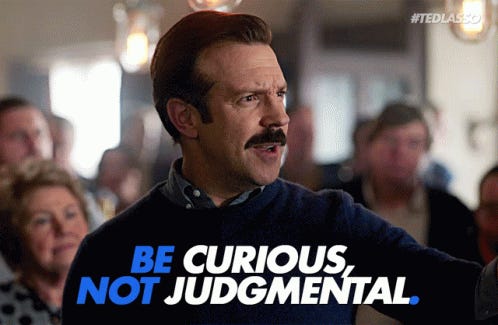
I use this clip in almost every workshop. Ted Lasso plays darts against a man, Rupert, who has spent the whole story looking down on him. And Ted wins. Not because he is lucky. Because his opponent never once asked whether Ted could actually play. He judged. (If you have not seen this series - this is really fun to watch - it will share good positive vibes). That is the risk. Judgment feels like efficiency. You size up the situation fast, you decide, you move on. And you lose, because you never checked. The same thing happens inside teams. If people feel judged for asking a basic question, or for trying something that does not work, they stop trying. Then you have a team full of people protecting themselves instead of learning. ✏ Curiosity is the real VUCA skillYou know VUCA: Volatility, Uncertainty, Complexity, Ambiguity. The acronym is old, but the world it describes has never been more real, especially with geopolitical context (eg MFN), climate change, and AI moving the ground under our feet every few months. In a VUCA world, the skills that matter most are dealing with ambiguity, sitting with polarity (two things being true at once), and staying steady while everything changes around you. One thread runs through all three: curiosity. Curiosity is a sustained and growing attention to a subject over time, a strong desire to understand, learn, and discover. Curiosity requires perseverance (true understanding takes time, no matter what AI can do for you 😉). It triggers dopamine, motivating exploration. It’s a marker of mental health, and research has shown that learning new skills prevents cognitive decline in Alzheimer disease. ✏ 7 benefits, for you and for your teamAlone or as a team, the same things improve once you build your curiosity muscles. This is what I notice in my own practice and in the team I coach:
One warning, and it matters. Do not build a culture of curiosity unless you are ready to act on what comes back. Research on curiosity in organizations found a strange disconnect: leaders encourage curiosity, then react badly when it actually shows up. Asking people to be curious and then ignoring what they bring you does not create engagement. It creates frustration. Below, I explain 3 tips to improve your curiosity in more detail. ✨ Hack✏ Tip 1: Write your twelve favorite problemsI found this in Building a Second Brain by Tiago Forte. I love the book. He tells the story of Richard Feynman, a Nobel Prize physicist. But what I like is the rest of him. Feynman played the bongo drums. He learned to draw. He taught himself to pick locks and he learned Portuguese. Same man, very different playgrounds. Curiosity was not a side project for him. It was how he lived. Feynman kept a dozen open questions permanently in his head. Not to solve them fast. Just to hold them. Then every time he read something new, heard a trick, or met an interesting person, he tested it against his twelve. Most of the time, nothing. Once in a while, a hit. People called it genius. It was really a well-prepared mind. Here are 4 of my open questions:
So write yours. Start with five. Real questions you keep circling back to: work and/or life. This helps you choose the book you read, the podcasts you listen to, and your next career move. Then do it with your team. When a team knows the real questions it has to solve, curiosity stops being a nice value on a poster. It becomes automatic. Every article, every tool, every conversation with customers gets tested against those questions. Ask your team this week: do we know what we are actually trying to answer? ✏ Test again what did not work beforeGo back to what failed. Six months ago you tried AI for something and it was bad. Too generic, wrong output, more work than doing it yourself. So you dropped it. Normal. But the tool changed. The models changed. Your own skill changed too. Curiosity is not only about new things. It is also the energy to re-test old disappointments. Keep a short list of your failed attempts. Revisit it on purpose, once a quarter. Ask: is there new data, a new tool, a better way to ask? Do it small. One pilot, one document, one test. Then look honestly and decide if it now reaches your standard. My own recent discovery: building slides with AI (it's great! - I said for 12 months Copilot was useless - not anymore 😅) and running a AI chief of staff to prepare my week. ✏ Before challenging conversation: reset your curiosityJeff Wetzler has a tool I like, published in HBR last summer. He calls it the Curiosity Check. Five minutes, before any conversation that matters. It starts with an honest question: if this person pushes back today, where will my head go? This could be a client or a team member. He maps six possible zones. Three sit on the certainty side. Three sit on the curiosity side. Most of us walk into high-stakes conversations from the certainty side. It feels like confidence. It is mostly armor. Then the useful part. Do not aim for fascinated wonder, you will not get there and you will feel like a fraud trying. Move one or two zones to the right. From confident dismissal to cautious openness. That is a real shift and it is doable. To make the shift, he suggests small questions you ask yourself first. My three favorites, adapted:
This is lately one of my favorite topics in my coaching with leaders building innovation capabilities, MFN strategy, or AI adoption like here. That's it for today. See you in two weeks. Keep the spark alive, and be intentional :) What's up with me? I have been on vacation for almost a month and have had the pleasure of sailing extensively in Brittany, France. Coming back to work with a lot of energy from fresh ocean vibes. I hope you could also enjoy some nice time off and not too many heat waves... ✨ Sources:
→ The Right Way to Prepare for a High-Stakes Conversation Here
Reader, hit reply to let me know if you liked this edition or if you tried these tips. I respond to every person who writes to me! |
Spark to Hack ✧
Hi, I'm Aurélie, a "coachultant" (certified systemic coach + consultant) and facilitator, specialized in innovation in healthcare and sustainability. I enable teams and leaders to accelerate from initial ideas to 1st pilot, GenAI been one of many ressource. I support big pharma (Roche, Pfizer, MSD...) and accelerators in AI, Digital health and medtech. I bring creativity and disciplined methods with contagious energy and smile. I have a No BlaBla, No Bullshit, and no Blingbling values. I am an entrepreneur & Mum of 3 boys aware that I only have one life, so I want to make the most of it!